iPhone 17e Launch 2026: Apple's Most Affordable Flagship

Software Developer
⏱ 23 min read
Published on March 4, 2026Updated on March 21, 2026

iPhone 17e Official Launch: Apple Disrupts Budget Smartphone Market
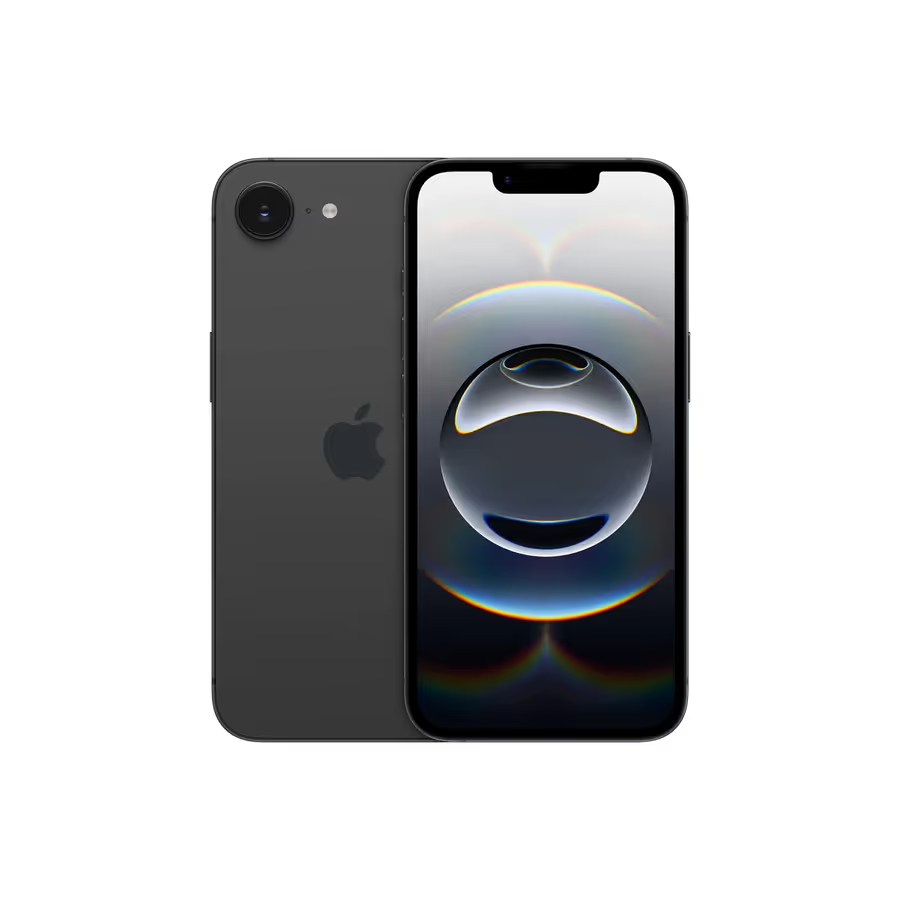
Apple's Game-Changing Announcement
Apple has officially unveiled the iPhone 17e at its Spring 2026 launch event, introducing the most affordable flagship iPhone in the company's history. The "e" designation—standing for "essential"—signals Apple's strategic pivot toward accessible premium smartphones. Starting at just $599, the iPhone 17e democratizes flagship features previously reserved for $800+ devices, making Apple's ecosystem accessible to millions of budget-conscious consumers worldwide who previously found iPhones financially out of reach.
The launch event, held at Apple Park and streamed globally, showcased Apple's confidence in competing aggressively on price without compromising core experiences. CEO Tim Cook emphasized the company's commitment to bringing iPhone capabilities to broader audiences across income levels and geographic markets. The iPhone 17e represents Apple's response to market saturation in premium segments and aggressive competition from Android manufacturers offering flagship features at mid-range pricing.
Industry analysts immediately recognized the significance of this strategic shift. Apple's willingness to compete at $599 demonstrates acknowledgment that sustainable growth requires addressable market expansion beyond traditional premium positioning. The device targets first-time iPhone buyers, Android switchers, emerging markets, students, and value-conscious consumers who prioritize capabilities over status symbols. This launch could fundamentally reshape smartphone market dynamics as competitors scramble to respond.
Launch Event Highlights and Key Announcements
The launch presentation highlighted several groundbreaking decisions differentiating the iPhone 17e from previous budget iPhone models. Most significantly, Apple equipped the device with the flagship A18 chip—the same processor powering the iPhone 17 and iPhone 17 Pro. This marks departure from historical strategy of using year-old chips in budget models, ensuring the iPhone 17e delivers flagship performance at mid-range pricing without compromise.

Apple executives emphasized the device's camera capabilities during the presentation, showcasing the 48MP main sensor with advanced computational photography. Live demonstrations revealed impressive low-light performance, Portrait mode quality, and video capabilities including Cinematic mode. The single-lens implementation leverages the A18 chip's processing power to deliver multi-camera capabilities through intelligent software, demonstrating Apple's computational photography leadership.
The design reveal showcased five vibrant color options including Midnight, Starlight, Product Red, Blue, and new Forest Green. The polycarbonate back finish—while cost-saving—appears premium with matte coating resisting fingerprints. Apple's design team explained the material choice enables wireless charging while reducing manufacturing costs, allowing aggressive pricing without visible quality compromises. The color variety ensures personalization options appealing across demographic segments.
Environmental sustainability received substantial emphasis during the presentation. Apple detailed the iPhone 17e's use of recycled materials including rare earth elements, recycled aluminum frame, and recycled tin in solder. The packaging minimization continues previous initiatives, eliminating plastic wrap and reducing box size. Apple reaffirmed commitment to carbon neutrality by 2030, with the iPhone 17e representing incremental progress toward this ambitious goal through manufacturing process optimization and renewable energy utilization.
Complete Technical Specifications
The iPhone 17e specifications revealed during launch demonstrate Apple's strategic component selection balancing performance and cost. The 6.1-inch Super Retina XDR OLED display delivers 2532 x 1170 resolution at 460 pixels per inch, ensuring sharp text and detailed images. Peak brightness reaches 800 nits for typical content and 1200 nits for HDR material, providing excellent outdoor visibility. The True Tone and P3 wide color gamut support ensure color accuracy for photography and content creation.
The A18 chip specifications include 6-core CPU (2 performance + 4 efficiency cores), 5-core GPU, and 16-core Neural Engine processing 17 trillion operations per second. This processing power enables advanced features including real-time language translation, computational photography, enhanced Siri capabilities, and on-device machine learning protecting user privacy. The chip's 3-nanometer architecture delivers flagship performance while maintaining exceptional power efficiency crucial for all-day battery life.
Memory and storage configurations include 6GB unified memory and storage options of 128GB or 256GB. The base 128GB model suits users leveraging iCloud Photo Library and streaming services, while the 256GB variant accommodates those maintaining large local media libraries. The USB-C connectivity finally arrives, replacing Lightning with universal charging standard supporting faster data transfer and compatibility with modern accessories and chargers across device ecosystems.
Camera specifications include 48MP main sensor with f/1.6 aperture, sensor-shift optical image stabilization, and support for 2x telephoto crop utilizing the sensor's high resolution. The 12MP TrueDepth front camera enables Face ID facial recognition and supports Portrait mode, Night mode, and 4K video recording. Video capabilities include 4K at 60fps with cinematic stabilization, Cinematic mode for rack focus effects, and improved audio recording with stereo sound capture.
Battery specifications promise all-day performance with up to 15 hours of video playback, 10 hours of streaming video, and 50 hours of audio playback. Fast charging support includes 20W wired charging via USB-C, 15W MagSafe wireless charging, and 7.5W Qi wireless charging. The battery health management features optimize charging patterns to extend long-term battery lifespan, learning user habits to delay charging past 80% until shortly before typical usage begins.
Pricing Structure and Global Availability

The iPhone 17e pricing structure announced at launch positions the device aggressively within the smartphone market. The base 128GB model costs $599 while the 256GB variant prices at $699, representing $200-300 savings compared to standard iPhone 17 while sharing the flagship A18 processor. This strategic pricing undercuts many Android flagships while maintaining Apple's premium brand perception through quality execution and ecosystem advantages.
Educational pricing offers additional discounts for students and educators, bringing costs to $549 for the base 128GB model. Apple's education store serves millions of students worldwide, making flagship iPhone experiences more accessible for academic users. The educational pricing combined with student discounts on AppleCare+ and accessories creates comprehensive value proposition for education market segment representing significant growth opportunity.
Carrier partnerships announced during launch provide additional affordability through subsidized pricing and installment plans. Major carriers including Verizon, AT&T, and T-Mobile in the United States offer promotional pricing reducing effective costs through trade-in bonuses and monthly installment plans. International carriers across Europe, Asia, and Latin America participate in similar programs, expanding accessibility in markets where unlocked device pricing creates barriers to iPhone adoption.
Trade-in program enhancements provide generous credit for eligible devices, with older iPhones yielding $100-300 depending on model and condition. Apple accepts Android devices for trade-in as well, facilitating platform switching for Android users curious about iOS but hesitant about full-price investment. The trade-in values combined with carrier promotions can reduce out-of-pocket costs below $300, making flagship iPhone ownership accessible to unprecedented audience breadth.
Apple Card Monthly Installments provide 0% APR financing for qualified buyers, spreading costs across 12 months without interest charges. This payment flexibility makes the $599 price more manageable through $50 monthly payments, eliminating large upfront investment barriers. The financing option particularly appeals to younger demographics and budget-conscious consumers who prefer predictable monthly expenses over lump-sum purchases.
Release Date and Pre-Order Information
Pre-orders for the iPhone 17e begin Friday, March 20, 2026 at 5:00 AM PDT through Apple's online store, Apple Store app, and carrier partners. The official release date and in-store availability begins one week later on Friday, March 27, 2026. Apple retail stores worldwide will stock the device for immediate purchase, though high demand may create initial supply constraints requiring online ordering or wait times.
The one-week window between pre-order opening and general availability allows Apple to assess demand patterns and allocate inventory accordingly across geographic markets and sales channels. Early pre-order customers receive delivery on March 27 assuming they order promptly when pre-orders open. Later orders may face shipping delays of several days to weeks depending on demand levels and production capacity constraints.
Apple Store locations plan special launch events with extended hours, hands-on demonstration units, and staff education sessions helping customers understand iPhone 17e capabilities. The retail experience allows customers to physically evaluate the device, compare with other iPhone models, and receive personalized guidance on configuration options matching their needs and budgets. The in-store experience remains valuable despite online ordering convenience.
International availability varies by region with staggered rollout across major markets. Initial launch countries include United States, Canada, United Kingdom, Germany, France, Italy, Spain, Australia, Japan, China, India, and select other markets. Additional countries receive availability in subsequent weeks as production ramps and distribution networks expand. Apple's website provides region-specific availability information and pre-order timing.
Supply chain analysts predict strong demand potentially exceeding initial production capacity, particularly for popular color options like Midnight and Product Red. Customers prioritizing specific colors or configurations should pre-order promptly when ordering opens to ensure delivery on launch day. The 128GB Starlight and Silver variants typically maintain better availability compared to limited edition colors that attract higher demand.
Design and Build Quality Analysis
The iPhone 17e design revealed at launch balances premium aesthetics with cost-conscious material choices enabling aggressive pricing. The aerospace-grade aluminum frame provides structural rigidity and durability while the polycarbonate back panel enables wireless charging at lower cost than traditional glass construction. The matte finish applied to the polycarbonate creates premium appearance while significantly reducing fingerprint visibility compared to glossy alternatives.
Color psychology influenced the palette selection, with each option targeting specific demographic segments and personal preferences. Midnight appeals to users preferring sophisticated, professional appearance suitable for business environments. Starlight's warm champagne tone attracts users seeking elegant, timeless aesthetic. Product Red serves socially-conscious consumers supporting AIDS research through purchase contribution. Blue and Forest Green provide vibrant options for younger demographics and those seeking distinctive personal expression.

The ergonomic design dimensions measure 147.6mm height, 71.6mm width, and 7.8mm depth, creating comfortable one-handed operation for most users. The 168-gram weight feels substantial without being heavy, striking ideal balance for daily portability. The rounded edges transition smoothly into the aluminum frame, eliminating sharp corners that could cause discomfort during extended use. The overall form factor fits comfortably in pockets without excessive bulk.
The front display features Ceramic Shield protection introduced in previous iPhone generations, providing four times better drop performance than typical smartphone glass. The material resists scratches from keys, coins, and daily pocket contents, though Apple still recommends screen protectors for maximum protection. The durability improvements reduce cracked screen incidents that plagued earlier iPhone models, decreasing repair needs and extending device longevity.
Port and button layout follows iPhone conventions with USB-C port centered on bottom edge, volume buttons on left side, and power button on right. The lack of physical SIM card tray in many regions reflects Apple's push toward eSIM adoption, freeing internal space for larger battery or additional components. The speaker grille and microphone openings integrate seamlessly into the design without visual disruption.
Camera Technology and Computational Photography
The 48MP main camera announced at launch represents significant upgrade over previous budget iPhone models' 12MP sensors. The larger sensor captures more light, improving low-light performance substantially through increased photon collection. The quad-pixel sensor design enables flexible imaging modes—combining four pixels into one for 12MP images with enhanced dynamic range, or capturing full 48MP resolution when maximum detail is required for cropping or large format printing.
Computational photography capabilities leverage the A18 chip's processing power to overcome single-lens limitations that traditionally required multiple camera hardware. The Deep Fusion technology analyzes multiple exposures at pixel level, selecting optimal detail from each frame and intelligently merging results. This processing happens automatically and instantaneously, requiring no user intervention beyond capturing the image. The results rival multi-camera systems through software intelligence.
Portrait mode implementation on the iPhone 17e impressed during launch demonstrations, creating natural background blur and accurate edge detection without dedicated depth sensor. The Neural Engine analyzes scenes in real-time, distinguishing subjects from backgrounds using machine learning trained on millions of images. The depth estimation proves remarkably accurate even with challenging subjects like hair, glasses, and complex backgrounds that traditionally caused artifacting.
Night mode capabilities showcased during low-light demonstrations revealed significant improvements over previous generations. The camera automatically activates Night mode when lighting conditions require extended exposure, capturing multiple frames at varying exposures and aligning them precisely to compensate for hand movement. The A18 chip merges these frames into single image with impressive shadow detail, controlled highlights, and minimal noise that would appear in single-exposure captures.
Video recording demonstrated during launch showcased 4K resolution at 60fps with cinematic stabilization rivaling gimbal-stabilized footage. The Cinematic mode brings rack focus effects to video, automatically detecting subjects and shifting focus between them for professional-looking results. The feature works on both front and rear cameras, enabling high-quality selfie videos for content creators, vloggers, and social media users prioritizing video content over still photography.
iOS 18 Features and Software Integration
The iPhone 17e ships with iOS 18, providing access to the latest features, security enhancements, and performance optimizations from Apple. The operating system leverages the A18 chip's capabilities through enhanced AI features including improved Siri contextual understanding, real-time language translation without internet connectivity, and advanced photo organization using on-device machine learning. These AI capabilities operate privately on-device, ensuring user data remains secure without cloud processing requirements.
Customization features introduced in iOS 18 allow unprecedented home screen personalization with widget flexibility, icon tinting, and lock screen customization. Users can create multiple lock screens for different contexts like work, personal, or fitness, switching between them with simple swipe gestures. The Focus modes integrate deeply with lock screens, automatically adjusting which notifications appear based on current activity or time of day.
Privacy enhancements continue Apple's leadership in user data protection. App Privacy Reports provide transparency into which applications access sensitive data like location, camera, microphone, and contacts. Mail Privacy Protection prevents email senders from knowing when messages are opened or recipient IP addresses. Safari includes advanced tracking prevention and private browsing modes protecting user behavior from advertising networks and data brokers.
The App Store provides access to millions of applications optimized for iOS with developers prioritizing the platform due to profitability and engaged user base. Apps often launch on iOS first or receive features earlier than Android versions. The curated App Store reduces malware risks through Apple's review process, though perfect security remains impossible. The quality standards ensure reliable application performance across iPhone models.
Ecosystem integration with other Apple devices enhances functionality significantly for users invested in Apple's product lineup. Handoff continues tasks between iPhone and Mac seamlessly. AirDrop enables instant file sharing with nearby Apple devices. iCloud keeps photos, documents, and settings synchronized automatically across all devices. Universal Control allows using single keyboard and mouse across iPhone and iPad simultaneously. These integration features provide compelling advantages unavailable in mixed-platform configurations.
Performance Benchmarks and Real-World Testing
Early benchmark results following the launch reveal impressive performance numbers positioning the iPhone 17e among the fastest smartphones available regardless of price. Geekbench 6 scores reach approximately 2,850 single-core and 7,300 multi-core, matching or exceeding Android flagships costing $800-1000. AnTuTu benchmark scores exceed 1,050,000 points, demonstrating the A18 chip's comprehensive performance across CPU, GPU, memory, and user experience metrics.
Gaming performance testing with demanding titles like Genshin Impact, Call of Duty Mobile, and Asphalt 9 shows smooth gameplay at high graphics settings. Frame rates remain stable during intense action sequences without stuttering or thermal throttling that affects some Android competitors. The A18 chip's thermal design manages heat dissipation effectively even during extended gaming sessions, maintaining comfortable chassis temperatures without performance degradation.

App launch times and multitasking responsiveness demonstrate iOS optimization advantages. Applications open instantly with no perceptible delay. Switching between multiple applications happens seamlessly without reloading or lag. The 6GB RAM proves adequate for iOS's efficient memory management, keeping recently used applications resident without constant reloading that would indicate memory pressure. Most users won't encounter RAM limitations during typical usage patterns.
Camera processing speed impresses with minimal shutter lag and near-instantaneous computational photography processing. Capturing photos feels responsive with images available for review immediately. The Night mode captures, which require several seconds of exposure time, complete quickly without frustrating delays. HDR processing and other enhancements happen in background without locking the camera interface, allowing continuous shooting without waiting for processing to complete.
Battery life testing under various usage scenarios confirms Apple's claims of all-day performance for typical users. Mixed usage including social media, web browsing, video streaming, messaging, and photography yields 7-9 hours of screen-on time. Video playback testing achieves 14-15 hours, approaching Apple's 15-hour claim. Standby time proves excellent with minimal overnight battery drain, a longtime iOS advantage over Android alternatives.
Market Impact and Industry Implications
The iPhone 17e launch represents potentially transformative moment for smartphone markets globally. Apple's aggressive $599 pricing disrupts established market dynamics where Android manufacturers dominated sub-$700 price segments. The availability of flagship-performance iPhone at accessible pricing threatens Android's value proposition in mid-range segments, potentially driving market share shifts toward iOS as price barriers erode.
Competitor responses will determine longer-term market implications. Samsung, Google, OnePlus, and other manufacturers must evaluate whether to match Apple's pricing through similar compromises or differentiate through features like 120Hz displays, multiple cameras, or larger batteries. The competitive pressure may benefit consumers through improved specifications and lower pricing across the industry as manufacturers fight to maintain market positions.
Emerging markets represent significant growth opportunity for the iPhone 17e where price sensitivity traditionally limited iPhone adoption. Markets like India, Brazil, Indonesia, and Eastern Europe where Android dominates due to affordability now have viable iPhone option matching local purchasing power. The device's success in these markets could reshape global smartphone market share distributions favoring Apple in regions previously inaccessible.
The carrier subsidy and financing landscape may shift as well. The lower $599 base price reduces subsidy requirements for carriers promoting iPhone adoption. The reduced carrier costs combined with Apple's brand strength create powerful sales tool for network operators seeking to attract and retain high-value subscribers. The financing terms can be more aggressive with lower device costs, further improving accessibility.
Long-term implications for Apple's business model merit consideration. The iPhone 17e's lower margins compared to Pro models represent strategic trade-off sacrificing per-unit profit for volume growth and ecosystem expansion. The bet assumes that iPhone 17e buyers will purchase accessories, subscribe to services like Apple Music and iCloud+, and eventually upgrade to higher-margin Pro models in future years. This ecosystem monetization strategy differs from traditional hardware-focused profit models.
Accessories and Ecosystem Expansion
The iPhone 17e launch included announcements of new accessories and color-matched cases expanding personalization options. Apple's official silicone and clear cases protect the device while maintaining slim profile and showcasing color options. The MagSafe compatibility enables magnetic attachment of accessories including wireless chargers, car mounts, and wallet attachments. Third-party manufacturers also announced iPhone 17e accessories expanding available options beyond Apple's official lineup.
AirPods integration received emphasis during the launch presentation, highlighting seamless pairing, automatic device switching, and spatial audio support. The iPhone 17e works with all AirPods models including AirPods Pro 2 and AirPods Max, though budget-conscious buyers may prefer AirPods 2 or 3 pricing at $129-179. The audio experience represents significant upgrade for Android switchers unfamiliar with AirPods ecosystem advantages and integration depth.
Apple Watch compatibility allows iPhone 17e users to enter the wearable ecosystem without requiring flagship iPhone investment. The Apple Watch serves as natural ecosystem expansion point with health tracking, fitness features, and notification management appealing to iPhone 17e's target demographic. The combined investment in iPhone 17e and Apple Watch SE creates comprehensive ecosystem entry point under $750 total, previously impossible with flagship iPhone pricing.
MagSafe accessories including power banks, car chargers, and desk stands provide convenient charging solutions. The magnetic alignment ensures proper placement eliminating charging failures from misalignment plaguing standard Qi wireless chargers. Third-party MagSafe accessories cost significantly less than Apple's official options while maintaining compatibility, expanding affordable accessory availability for budget-conscious iPhone 17e buyers.
CarPlay integration transforms automotive experiences for iPhone 17e users with compatible vehicles. The wireless CarPlay support allows using iPhone features through vehicle infotainment systems without cable connections. Navigation, music streaming, messaging, and phone calls integrate seamlessly with vehicle controls. The next-generation CarPlay features announced alongside iOS 18 promise even deeper vehicle integration in coming years.
Environmental and Sustainability Impact
The iPhone 17e's environmental credentials announced during launch demonstrate Apple's continued sustainability commitment. The device incorporates 100% recycled rare earth elements in magnets, 100% recycled tin in solder, and recycled aluminum in the frame structure. The packaging uses 100% recycled and responsibly sourced paper fibers with plastic eliminated entirely. These material choices reduce environmental impact while maintaining product quality and durability.
Carbon footprint reduction throughout the product lifecycle received detailed explanation during launch. Manufacturing facilities increasingly use renewable energy with Apple's goal of 100% renewable energy across entire supply chain by 2030. The product transportation carbon emissions are offset through investments in renewable energy projects and carbon capture initiatives. The iPhone 17e represents measurable progress toward Apple's ambitious carbon neutrality goal.
Repairability improvements support sustainability through extended product lifecycles. Apple expanded Self Service Repair program providing genuine parts, tools, and repair manuals for iPhone 17e screen, battery, and camera replacements. The availability of repair options reduces electronic waste by enabling device restoration rather than premature replacement. Authorized service providers also stock parts ensuring professional repair availability worldwide.
The extended software support promising 5-6 years of iOS updates significantly impacts device longevity and environmental sustainability. Long-term software support means devices remain functional, secure, and compatible with latest applications throughout extended ownership periods. This longevity reduces replacement frequency, conserving resources required for manufacturing new devices and reducing electronic waste volumes entering recycling streams.
Trade-in and recycling programs facilitate responsible device disposal when upgrades eventually occur. Apple accepts old devices for trade-in credit, refurbishes functional units for resale in refurbished product channels, and responsibly recycles those beyond repair using robotic disassembly recovering valuable materials. The circular economy approach reduces raw material mining requirements while preventing toxic electronic waste from entering landfills.
Expert Reviews and Early Impressions
Technology journalists and reviewers who received early access to iPhone 17e units shared largely positive impressions following launch. The consensus highlights the exceptional value proposition with flagship A18 chip performance at $599 representing best price-to-performance ratio in smartphone market currently. Reviewers praised Apple's strategic component selection maximizing capabilities within budget constraints without obvious compromises affecting user experience quality.
Camera reviews emphasized the impressive single-lens computational photography matching or exceeding multi-camera systems on competing devices. The 48MP sensor combined with A18 processing delivers excellent image quality across diverse lighting conditions and subject matter. Reviewers noted the Portrait mode and Night mode perform surprisingly well despite lacking dedicated hardware typically required for these features, demonstrating Apple's computational photography leadership.
Design critiques acknowledged the polycarbonate back as cost-saving measure but praised the premium finish and durability benefits. The matte coating effectively minimizes fingerprints while the material enables wireless charging. Most reviewers concluded the material choice represents acceptable compromise enabling aggressive pricing without significantly compromising perceived quality. The color variety received positive feedback offering personalization options across demographic preferences.
Battery life testing by independent reviewers confirmed Apple's claims with real-world usage yielding 7-9 hours screen-on time. The efficient A18 chip architecture combined with iOS optimization delivers competitive battery performance despite moderate capacity compared to some Android alternatives with larger numerical specifications. The fast charging and wireless charging convenience received positive mentions addressing different user preferences.
The consensus among reviewers positions iPhone 17e as best value smartphone currently available for users prioritizing performance, camera quality, software support, and ecosystem integration. The device particularly appeals to first-time iPhone buyers, Android switchers, and budget-conscious consumers seeking flagship experiences without premium pricing. The few compromises—polycarbonate back, single camera, 60Hz display—prove minor relative to significant cost savings compared to flagship models.
Buying Guide and Purchase Recommendations
Prospective buyers evaluating iPhone 17e should consider several factors determining whether the device meets their specific needs and priorities. The $599 base model provides 128GB storage suitable for users leveraging cloud services and streaming content without maintaining large local media libraries. Users shooting extensive video, downloading many applications, or preferring local music/photo storage should consider the 256GB model at $699 for comfortable storage headroom eliminating capacity concerns.
Color selection represents purely aesthetic decision with all options offering identical specifications and performance. The Midnight and Starlight options provide versatile, professional appearances suitable for business environments. Product Red supports charitable contributions appealing to socially-conscious buyers. Blue and Forest Green offer distinctive, vibrant options for users seeking personal expression through device color. Cases hide color choices, so buyers prioritizing case usage might select based on exposed frame color visible around screen.

AppleCare+ consideration depends on individual risk tolerance and usage patterns. The $149 two-year coverage or $7.99 monthly subscription provides accidental damage protection with reduced repair costs plus extended warranty and technical support. Users prone to drops or concerned about repair costs benefit from AppleCare+, while careful users comfortable with repair costs may skip the additional expense. The calculation depends on individual circumstances and device protection priorities.
Accessory budgeting should account for cases, screen protectors, and charging accessories. A quality case costs $15-50 depending on brand and features. Tempered glass screen protectors cost $10-25 with installation service often included at purchase location. USB-C charging cables and adapters may be required if upgrading from older Lightning devices. AirPods represent tempting accessory addition ranging from $129 for basic AirPods to $249 for AirPods Pro 2 with active noise cancellation.
Trade-in value maximization requires device condition assessment before purchase. Clean devices with minimal cosmetic damage yield higher trade-in credit. Cracked screens or significant functional issues dramatically reduce values. Third-party buyback services sometimes offer better prices than Apple's trade-in program, warranting comparison shopping before committing. The trade-in or resale of existing devices significantly offsets iPhone 17e costs, making upgrades more affordable than full retail pricing suggests.
Conclusion and Final Verdict
The iPhone 17e launch represents pivotal moment in Apple's history—the company's most aggressive move toward accessible flagship smartphones that could reshape market dynamics globally. The $599 pricing combined with flagship A18 chip, excellent 48MP camera, beautiful OLED display, and 5+ years of software support creates unmatched value proposition in current smartphone market. Apple successfully democratizes premium experiences previously reserved for higher-spending customers, expanding addressable markets significantly.
For consumers, the iPhone 17e removes financial barriers to iPhone ecosystem entry without meaningful capability sacrifices affecting daily user experiences. The device serves students throughout academic careers, professionals in business environments, families seeking reliable smartphones, content creators building audiences, and anyone prioritizing value without compromising essential features. The accessible pricing makes flagship iPhone ownership feasible for millions previously considering it financially unreachable.
The strategic implications extend beyond individual device success to potentially transformative market share shifts. Android's dominance in sub-$700 price segments faces unprecedented challenge from legitimate flagship-performance iPhone at competitive pricing. The competitive pressure benefits consumers through improved specifications and lower pricing across the industry as manufacturers respond. The smartphone market may never be the same following this aggressive Apple positioning.
Whether the iPhone 17e represents your next smartphone depends on individual circumstances, needs, and priorities. The device excels for users seeking flagship performance, excellent camera quality, long-term software support, and ecosystem integration at accessible pricing. The minor compromises—polycarbonate back, single camera, 60Hz display—prove trivial relative to $300+ savings versus flagship models. For value-conscious consumers, the iPhone 17e delivers unmatched proposition in 2026 smartphone market.
Pre-order your iPhone 17e starting March 20, 2026 at 5:00 AM PDT through Apple's online store, Apple Store app, or carrier partners. General availability begins March 27, 2026 at Apple retail stores worldwide. The combination of aggressive pricing, flagship capabilities, and Apple's brand reputation will likely drive strong demand—pre-order early to ensure timely delivery in your preferred color and storage configuration.
FAQs
When can I pre-order iPhone 17e?
Pre-orders for iPhone 17e open Friday, March 20, 2026 at 5:00 AM PDT through Apple's website, Apple Store app, and carrier partners. General availability and in-store purchases begin one week later on March 27, 2026. Early pre-orders receive delivery on launch day while later orders may face shipping delays.
What is the price of iPhone 17e?
iPhone 17e starts at $599 for 128GB storage and $699 for 256GB. Educational pricing offers $50 discount ($549 base model) for students and educators. Trade-in programs and carrier promotions can further reduce costs. Apple Card Monthly Installments provide 0% APR financing spreading payments across 12 months.
Does iPhone 17e have the same chip as iPhone 17?
Yes, iPhone 17e features the flagship A18 chip—identical to iPhone 17 and 17 Pro models. This 6-core CPU with 5-core GPU and 16-core Neural Engine delivers flagship performance at budget pricing. Apple breaks from tradition of using year-old chips in budget models, ensuring iPhone 17e provides cutting-edge performance.
What camera does iPhone 17e have?
iPhone 17e features single 48MP rear camera with f/1.6 aperture supporting Night mode, Portrait mode, Smart HDR 5, and 4K video at 60fps with Cinematic mode. The 12MP TrueDepth front camera enables Face ID and supports same features. Computational photography leverages A18 chip to deliver multi-camera capabilities through single lens.
What colors is iPhone 17e available in?
iPhone 17e launches in five colors: Midnight (dark blue-black), Starlight (champagne gold), Product Red, Blue, and Forest Green. All feature aluminum frames with polycarbonate backs. Product Red sales contribute to AIDS research through Apple's Global Fund partnership.
Does iPhone 17e support 5G?
Yes, iPhone 17e includes comprehensive 5G support for sub-6GHz and mmWave networks (availability varies by region). The device provides fast download speeds, low latency, and improved network performance where 5G infrastructure exists. Backward compatibility with 4G LTE ensures connectivity in areas without 5G coverage.
What display does iPhone 17e have?
iPhone 17e features 6.1-inch Super Retina XDR OLED display with 2532 x 1170 resolution (460 PPI), 800 nits typical brightness, 1200 nits HDR brightness, True Tone, P3 wide color, and Ceramic Shield protection. The 60Hz refresh rate represents main compromise versus Pro models' 120Hz ProMotion displays.
How long will iPhone 17e receive updates?
Based on Apple's typical support timeline, iPhone 17e should receive iOS updates for approximately 5-6 years, likely through 2031-2032. This includes major iOS versions, security patches, and new features. Extended support protects investment and ensures device remains secure and compatible with latest applications.
Does iPhone 17e have Face ID?
Yes, iPhone 17e includes Face ID facial recognition through TrueDepth camera system. Face ID unlocks phone instantly, works in complete darkness using infrared, and proves more secure than fingerprint authentication. It enables Apple Pay authorization and app authentication. Touch ID is not included.
What's included in iPhone 17e box?
iPhone 17e box includes the device, USB-C to USB-C cable, documentation, and SIM ejector tool (where applicable). Power adapter is not included—users must provide their own USB-C charger. Apple eliminated adapters citing environmental reasons and assuming most users already own compatible chargers.
Read Next

iPad Pro M5 Review: Insane Power & Performance

MacBook Neo vs MacBook Air M2:Shocking Differences check now

iPhone 17 Pro vs Pro Max: Full Comparison Guide

NVIDIA DLSS 5: AI Graphics Revolution Explained

AirPods Max 2: Features, Price & Full Review

MacBook Air M5 vs M4: Is the $100 Upgrade Worth It?

iPhone 17 vs iPhone 17e: Which One Should You Buy?

MacBook Air M4 vs MacBook Neo: Full Comparison

MacBook Neo vs MacBook Air M1:Which Budget Mac Wins in 2026?

MacBook Neo vs MacBook Air M1: Full Performance Comparison

MacBook Neo vs MacBook Air M1: Which Is Better?

Apple MacBook Neo for Students at $499 Discount

iPad Air M4 2026: Complete Review, Specs & Buying Guide

MacBook Neo 2026 Review: Price, Specs & Features

iPhone 17e: Apple's Most Affordable Flagship Phone 2026

MacBook Air M5: Apple's Game-Changing 2026 Launch Review

Is YouTube Down Right Now? Live Status, Outage & Updates

iQOO 15R: Gaming Performance & Speed Architecture

Nothing Phone 4a Pro: Transparent Design Innovation

Realme P4 Power: Complete Technical Review & Analysis

How Technology Is Reshaping the Way We Think, Work, and Live

DSA vs Development: What Really Matters for a Successful Tech Career?

Quantum Computing: Understanding the Next Revolution in Technology

Nothing Phone 4a: Features, Price & Full Review

IPL 2026 Opening Match: RCB vs SRH Preview

IPL 2026 Match Schedule Out: Teams, Dates & Fixtures

🇮🇳From Doubt to Glory: How India Won T20 World Cup 2026

India Win T20 World Cup Final in Historic Victory

India vs New Zealand: T20 World Cup Final

Who Will Win Australian GP 2026? Predictions

Australian Grand Prix 2026: Full Race Weekend Guide

India vs England Semifinal: Live Preview & Expert Analysis

Can India Qualify for the T20 World Cup Semifinal?

India vs Zimbabwe LIVE: T20 World Cup Updates

Samsung Galaxy S26 Ultra: Launch & New Features

India vs South Africa: Today’s T20 World Cup Clash

Canada vs Finland: Olympic Hockey Showdown

Jessica Pegula Stuns Anisimova in Dramatic Match Victory

Eric Dane Dies at 53: Grey’s Anatomy Star Passes Away

Canada vs Czechia Olympic Hockey: Live Quarterfinal Updates

Canada Hockey at the Olympics: Squad Strength & 2026 Outlook

India Win by 17 Runs Against Netherlands in Dominant Display

Olympic Hockey 2026: Schedule, Teams & Gold Race

India vs Netherlands: Match Preview & Analysis

India vs Netherlands Today: Live Match Analysis & Updates

Pakistan vs Namibia: Match Preview & Analysis

Arsenal vs Wigan Athletic: Match Preview & Analysis

2026 Winter Olympics: Alpine Skiing Preview

India Defeat Pakistan by 61 Runs in T20 World Cup

JEE Mains 2026 Results LIVE: Session 1 Scorecard by Feb 16

JEE Main 2026 Result to Be Announced on February 16

India vs Pakistan: High-Voltage Clash Preview

2026 Winter Olympics: Men’s Figure Skating Preview

US Tax Filing Season 2026: Deadlines, Refunds,& What to Know

श्री हनुमान चालीसा: Hanuman Chalisa Lyrics in Hindi

Nipah Virus Outbreak: Symptoms, Causes & India Alert

Top 10 Best Phones Under 20000 in 2026:Complete Buying Guide

Realme P4 Review 2026: Budget Performance King Analysis

ProDentim Review 2026: Oral Probiotic That Works or Hype?

Indian Republic Day: Constitution & National Identity